
Starship Troopers
Find the movies with rewatch gravity, live dossiers, and unfinished cases worth deepening.
Movie dossier
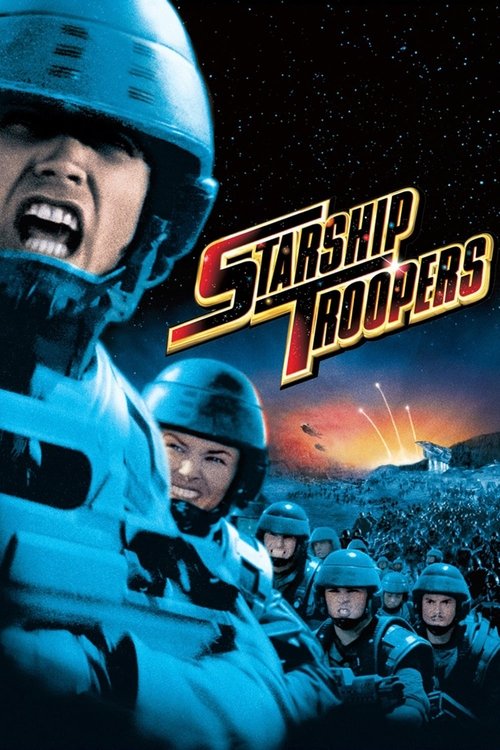
Starship Troopers
Paul Verhoeven makes fascist propaganda look like a clean teen-war adventure, then lets the joke curdle in your mouth.
Latest video signal
Trailer slot ready
A widescreen slot for the newest official trailer, interview, or scene signal when the page has a playable source.
Why it matters
Starship Troopers belongs here because it gives Cinema One a cult sci-fi page with real argument gravity. The movie works as bug-war spectacle, but the deeper rewatch charge is Verhoeven making the sales pitch too clean: beautiful recruits, heroic sacrifice, classroom certainty, newsreel violence, and a government that turns every corpse into another recruitment button. It is a danger-hangout where the hangout is the trap.
Craft read
Teen enlistment melodrama fused to monster-war action and recruitment-video satire
Every heroic beat is also evidence of a society teaching young people to enjoy obedience, revenge, and permanent war
The first watch gives you bugs and carnage; the second watch makes the commercials, smiles, uniforms, and classroom slogans feel radioactive
Themes
Cast and context
fascist satire • propaganda • bugs • mobile infantry • media militarism • paul verhoeven • cult sci-fi
Coverage status
A strong case file with real editorial shape: enough craft, context, and connection to guide a serious watch.
Production notes
- • American Cinematographer reported that Jost Vacano had to compose battle scenes around bugs that were not physically in the frame, using cutouts, poles, flags, eyelines, and scale discipline so the digital creatures could feel like actual scene partners.
- • In Interview Magazine, Verhoeven described the movie’s “dreamlike fascism” as a dream that becomes a nightmare, which is the clearest way into why the film’s clean surfaces are supposed to feel suspicious.
- • The Guardian’s 25-year reassessment connects the casting, uniforms, propaganda clips, and Empire-cited Verhoeven remarks to the film’s anti-fascist design: the movie wants the audience to ask whether these people are crazy while still feeling the pull of the spectacle.
Watch-next pathway
What should you do after Starship Troopers?
Three intentional continuations: stay with the filmmaker, chase the dominant pressure signal, or jump into the shelf or argument that best explains why this movie belongs here.
RoboCop
The cleanest next move if Paul Verhoeven's control, obsessions, or rhythm are what hooked you here.
More propaganda
Use the taste map to find movies, arguments, and shelves that share this page's strongest signal.
Tension Machines
Command decisions, brinkmanship, pressure, and movies that tighten the screws scene by scene.
Movie-page argument
Defend Starship Troopers.
If this movie has a scene, performance, ending, or idea people underrate, make the case. The best defenses can become future Cinema One argument material.
Scene challenge
Pick the scene that proves it.
Cinema One is built around scenes that unlock the movie. Tell us which moment carries the pressure, style, argument, or rewatch charge.
Signature scene: Klendathu turns heroic advertising into meat-grinder evidence
The first major bug assault is staged like the ad campaign finally meeting reality. The uniforms are clean until they are not, the dropship confidence collapses into screaming geography, and the newsreel version of courage cannot edit fast enough to hide the bodies. Verhoeven lets the scene be exciting, then makes the excitement incriminate the system that sold it.
Line worth carrying forward
“Would you like to know more?” is the movie’s real command phrase. It sounds like a playful clickable button, but it keeps training the audience to accept propaganda as interface: another clip, another certainty, another little push toward war as entertainment.
Why the ending is not victory
The captured Brain Bug should play like triumph, but the scene is almost grotesquely cheerful. The characters grin because the state has taught them what winning is supposed to look like, while the movie has spent two hours showing that every victory just manufactures the next recruitment cycle.
Steelman the debate
The easy critique is that Starship Troopers is too blunt, too plastic, or too pleased with its own violence. The defense is that the plastic is the point. Verhoeven is not hiding the satire under realism; he is making the propaganda glossy enough that viewers have to notice their own appetite for it.
Shows up in
Command decisions, brinkmanship, pressure, and movies that tighten the screws scene by scene.
Movies built for return visits, momentum, quotability, texture, and pure replay value.
The lane where personality beats polish and cult energy becomes part of the pleasure.
Cold systems, synthetic threats, and movies where technology stops feeling like a tool and starts feeling like an adversary.
More from this director
Read next
Paul Verhoeven’s classic is not just a cyborg action movie, it is a brutal joke about what happens when corporate logic gets hold of the human body.
Cameron’s sequel works because it does not simply supersize Ridley Scott’s terror. It rebuilds the xenomorph threat around group collapse, siege pressure, and Ripley’s protective ferocity.
Tarantino’s war fantasia works because the suspense is not built on firefights first. It is built on who can control the room, the accent, the cover story, and the next sentence.