
Tropic Thunder
Find the movies with rewatch gravity, live dossiers, and unfinished cases worth deepening.


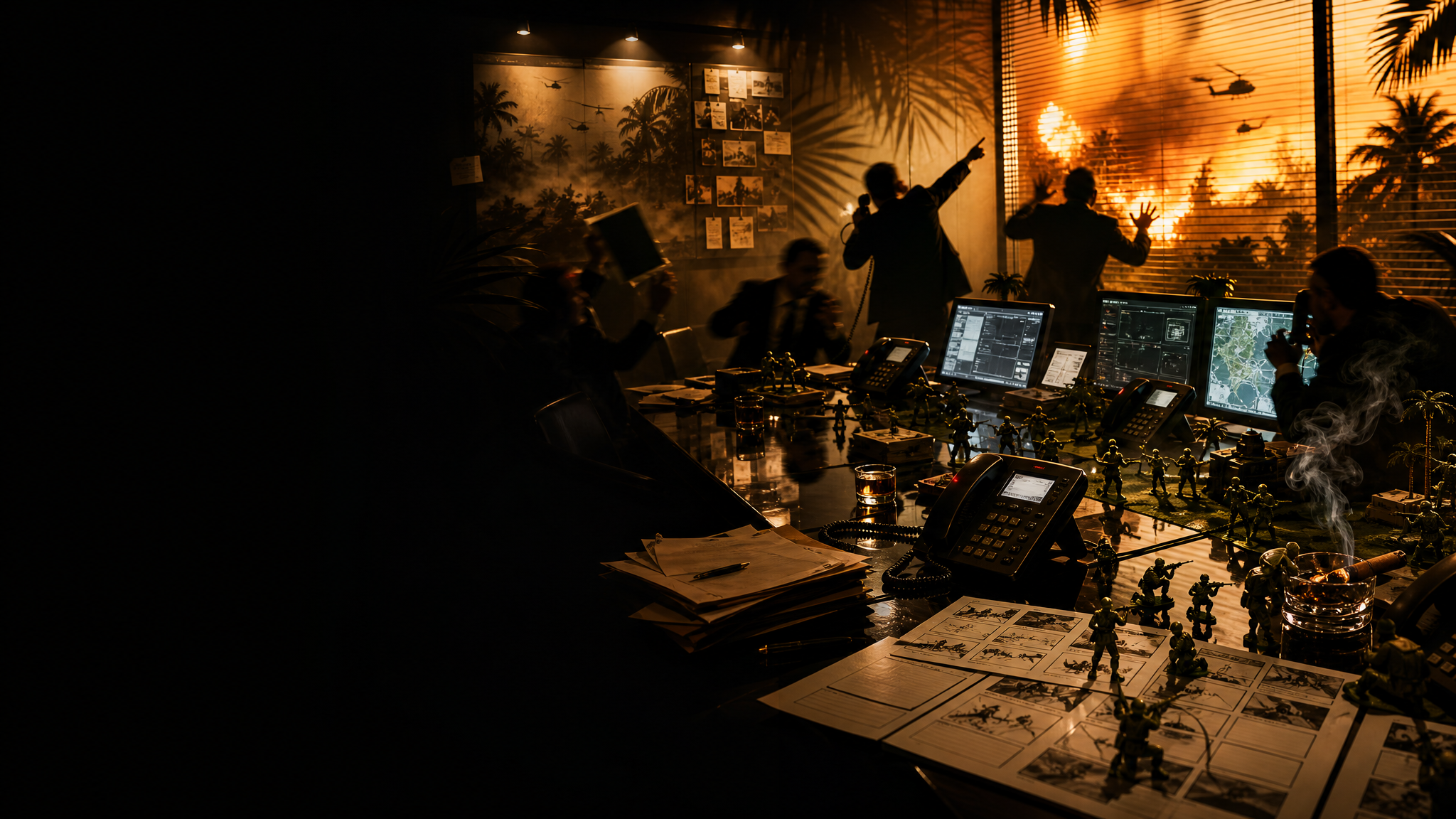
Movie dossier
Tropic Thunder
A dangerous studio-comedy miracle: fake trailers, jungle chaos, actor pathology, and Hollywood self-loathing detonated at blockbuster scale.
Latest video signal
The official trailer sells the joke as blockbuster war spectacle first
The trailer matters because it leads with scale, explosions, and movie-star chaos before the satire fully announces itself. That is the Tropic Thunder trick: it has to look enough like a war blockbuster to make the parody expensive.
Why it matters
Tropic Thunder matters because it is not merely a comedy about actors lost in a war movie. It is a movie about Hollywood confusing performance, pain, spectacle, and branding until everyone involved becomes morally ridiculous. Ben Stiller builds the joke as an industrial machine: fake trailers first, ego profiles next, then a jungle survival plot that keeps exposing how little these people understand about craft, danger, or reality. The reason it still plays is not that every joke is clean. It plays because the movie understands exactly how dirty the engine is.
Craft read
A fake-marketing prologue, ensemble ego grid, and action-movie survival plot all working as one satire system
Downey, Cruise, Stiller, Black, Jackson, and Baruchel each attack a different Hollywood delusion rather than chasing the same joke
The movie gets funnier when you track how every gag is also a note about awards, branding, franchise fatigue, studio power, or actor vanity
Themes
Cast and context
hollywood • war movie • method acting • vietnam • satire • parody
Coverage status
A fully shaped Cinema One case: the movie has enough authored context, pathway links, and argument to feel like more than a catalog entry.
Production notes
- • The fake trailers are not decoration. They are the movie’s opening argument: before the plot starts, Tropic Thunder has already mapped the careers, brands, awards hunger, and genre cages that will trap the characters.
- • Robert Downey Jr.’s Kirk Lazarus works only if the viewer reads the target precisely: not Blackness, but a prestige actor so intoxicated by transformation that he treats identity as raw material for trophies.
- • Brandon T. Jackson’s Alpa Chino is structurally crucial because he keeps puncturing Lazarus from inside the movie rather than leaving the audience to supply the critique from outside.
- • Tom Cruise’s Les Grossman detonates because he reveals the studio executive as the hidden warlord of the picture: vulgar, insulated, childish, violent, and more powerful than any actor pretending to be dangerous.
- • The movie’s scale matters. This is one of the late major examples of an R-rated studio comedy that could still look expensive, stage action with real production muscle, and spend blockbuster resources on insulting blockbuster culture.
Watch-next pathway
What should you do after Tropic Thunder?
Three intentional continuations: stay with the filmmaker, chase the dominant pressure signal, or jump into the shelf or argument that best explains why this movie belongs here.
More performance
Use the taste map to find movies, arguments, and shelves that share this page's strongest signal.
Rewatchables
Movies built for return visits, momentum, quotability, texture, and pure replay value.
Movie-page argument
Defend Tropic Thunder.
If this movie has a scene, performance, ending, or idea people underrate, make the case. The best defenses can become future Cinema One argument material.

Scene challenge
Pick the scene that proves it.
Cinema One is built around scenes that unlock the movie. Tell us which moment carries the pressure, style, argument, or rewatch charge.
Cinema One case file
The argument this page is making
The movie is a satire of people who use art language to launder ego, cowardice, exploitation, and career panic.
The jokes are not random shock bits. The best ones are aimed at systems: awards bait, method mythology, franchise exhaustion, branding, studio cruelty, and prestige self-seriousness.
The movie asks the audience to distinguish target from tool. That makes the satire potent, but also fragile: if the target is missed, several jokes can curdle fast.
Watch the first ten minutes as the whole movie in miniature. Every fake trailer tells you exactly which Hollywood disease that performer is carrying into the jungle.
Production file
How the movie became this object
The fake trailers are the skeleton key
Scorcher VI, The Fatties, Satan’s Alley, and the Booty Sweat ad do more than get laughs before the story starts. They establish the movie as a fake multiplex where every star is already trapped by a market identity. Tugg is franchise desperation, Portnoy is gross-out repetition, Lazarus is prestige hunger, and Alpa Chino is brand extension. The jungle plot simply strips those brands until they malfunction.
Kirk Lazarus is a joke about acting as colonization
Downey’s performance is the page’s hardest read because the movie is using an offensive image to attack a specific kind of actorly entitlement. Lazarus believes commitment gives him permission to occupy anything. The joke needs Alpa Chino’s resistance, Lazarus’ absurd seriousness, and the movie’s awards-satire context to keep the target visible.
Les Grossman reveals the real monster off set
Grossman is funny because Cruise does not play a cameo. He plays a whole power system with hairy hands, Diet Coke rage, and dance-floor obscenity. The character turns the studio executive into a creature feature: someone who cannot make art, cannot endure risk, and still decides everyone’s fate.
The movie understands war cinema as costume and posture
Tropic Thunder is built from the visual grammar of Vietnam and jungle war pictures, but the target is not combat. The target is Hollywood’s appetite for converting trauma into heroic self-image. The actors keep borrowing the seriousness of war movies without earning the gravity behind it.
The controversy is part of the case, not a footnote
A 9/10 page cannot pretend the movie is simply “edgy.” The disability-language protests and the continuing debate over Lazarus are central to how the film is remembered. The useful Cinema One stance is to read the satire sharply while admitting that the tools are volatile and not every viewer is obligated to accept the bargain.
Scene architecture
The moments that change the machine
Opening trailer run: the joke before the movie is the thesis
The fake trailers make the audience fluent before the plot begins. Each one compresses a career critique into a miniature artifact: sequel fatigue, gross-out laziness, prestige sanctimony, and commercial self-parody. It is one of the smartest prologues in modern studio comedy because it makes world-building out of industry mockery.
“I’m a dude…”: identity collapses into pure performance logic
The famous Lazarus line works because it is not only verbal gymnastics. It is the character’s whole sickness expressed as a loop: self, role, disguise, role inside role, all defended as craft. The comedy is in how proudly he explains the insanity.
Les Grossman dancing: power turns itself into vulgar spectacle
The dance is not random. It is the movie letting hidden power become visible and grotesque. Grossman does not need dignity because he already owns the room. That freedom from shame is exactly what makes him monstrous and hilarious.
The Oscar ending: Hollywood eats the evidence
The ending completes the loop by turning disaster into prestige validation. The system does not learn; it repackages. That is why the Oscar beat is sharper than a normal happy ending. The movie knows Hollywood can metabolize almost anything if the campaign is good enough.
Confirmed so far
- • Ben Stiller directed, co-wrote, produced, and starred in the film.
- • The main ensemble includes Stiller, Jack Black, Robert Downey Jr., Brandon T. Jackson, Jay Baruchel, Steve Coogan, Danny McBride, Nick Nolte, Matthew McConaughey, and Tom Cruise.
- • The movie opens with fake advertisements and trailers that establish the fictional screen careers and brands of the actors inside the story.
- • Robert Downey Jr. received an Academy Award nomination for Best Supporting Actor for playing Kirk Lazarus.
- • Ben Stiller has since discussed how difficult it would be to mount a film like Tropic Thunder at the same scale in the current comedy and studio environment.
- • Reporting and interviews have repeatedly noted that Tom Cruise pushed the Les Grossman look and dance into the character’s comic identity.
What to watch for
- • On rewatch, track how every actor is performing a different failure mode: insecurity, addiction, prestige narcissism, brand hustle, or sane-person exhaustion.
- • Watch Brandon T. Jackson’s reactions; Alpa Chino is the pressure valve that keeps the Lazarus satire from floating free of critique.
- • Notice how often the movie turns fake products, fake trailers, fake memoir, fake heroism, and fake authenticity into the same disease.
- • The action staging matters more than people remember. The comedy lands harder because the movie has enough production scale to look like the thing it is attacking.
- • The ending should be read cynically: Hollywood has not been corrected, it has found a better awards narrative.
Open questions
- • Does the movie’s satirical target stay clear enough for new viewers, or does some of the shock comedy now overwhelm the intended critique?
- • Is Tropic Thunder the last great expensive R-rated studio comedy of its kind, or just one of the loudest artifacts from that disappearing lane?
- • Would the movie work without Downey’s performance, or is the entire structure dependent on that one volatile comic gamble?
- • Does Les Grossman steal the film in a way that sharpens the satire, or does the cameo become its own separate meme object?
- • How should Cinema One frame comedy that remains genuinely funny while also carrying jokes some viewers reasonably reject?
Signature scene: the fake trailers establish the whole satire in one blast
The opening trailer run is Tropic Thunder doing elite compression work. In a few minutes the movie invents careers, brands, formulas, scandals, awards thirst, franchise rot, and performer insecurity. The plot has not started, but the target is already locked: Hollywood as a machine where identity becomes marketing copy and seriousness becomes costume.
Line worth carrying forward
“I’m a dude playing a dude disguised as another dude” is the cleaner carry-forward line because it contains the whole movie. Lazarus says the quiet part as a riddle: performance has become so layered that identity no longer means anything except commitment to the bit.
Why the ending works as industry loop instead of clean escape
Tropic Thunder closes by feeding the ordeal right back into the machine. The Oscar finish is funny because it is spiritually bleak: no one is cured, the system is not punished, and Hollywood has simply transformed breakdown, violence, and delusion into a prestige narrative it can applaud.
Steelman the debate
The strongest critique is that Tropic Thunder asks viewers to grant a lot of satirical trust, and some of its tools are so volatile that the target can blur or cause damage before the critique lands. The strongest defense is that the movie is unusually clear about its real enemy: not marginalized people, but the entertainment industry’s habit of turning other people’s pain, identity, trauma, and seriousness into career fuel. A 9/10 read has to hold both truths at once.
More from this director
Related picks
Read next
Cameron’s action-comedy stays watchable because it never treats the marriage plot as filler. Embarrassment, deception, and spectacle are all part of the same propulsion system.
Cameron’s sequel works because it does not simply supersize Ridley Scott’s terror. It rebuilds the xenomorph threat around group collapse, siege pressure, and Ripley’s protective ferocity.
James Cameron’s sequel gets larger, louder, and more advanced, but it stays alive because every escalation feeds the movie’s protector-child-parent triangle.