
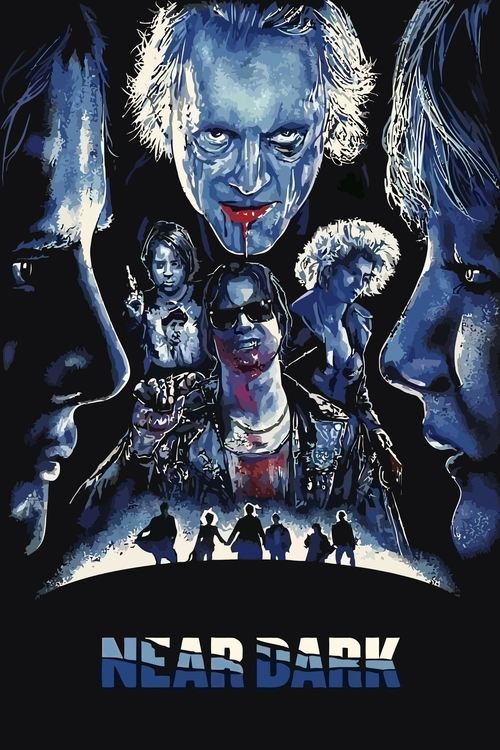
Near Dark
Find the movies with rewatch gravity, live dossiers, and unfinished cases worth deepening.

Movie dossier
Near Dark
Kathryn Bigelow strips vampire mythology down to night roads, outlaw family, dirty neon, and the terror of sunrise.
Latest video signal
Trailer slot ready
A widescreen slot for the newest official trailer, interview, or scene signal when the page has a playable source.
Why it matters
Near Dark matters here because it fills the missing early-Bigelow link in the women-director breadth lane. Before Point Break turns adrenaline into religion and The Hurt Locker turns danger into addiction, this movie already understands appetite as a system. Caleb thinks he is entering a romance, but Bigelow keeps moving him into harder rooms: the stolen van, the motel, the bar, the daylight sprint, the family table where belonging means learning to feed. It is a cult page with real Cinema One gravity because the horror is not gothic elegance. It is dust, blood, speed, music, and people who treat the American road like a feeding route.
Craft read
A farm boy is bitten by a nomadic vampire woman and forced to survive inside her violent night-road family
The movie replaces castles and capes with vans, motels, bars, headlights, and sunrise deadlines, making vampirism feel like outlaw procedure
The second watch tracks how early Bigelow already builds action from bodies under rules: hunger, daylight, family loyalty, and the need to keep moving
Themes
Cast and context
near dark • kathryn bigelow • vampire western • bill paxton • lance henriksen • tangerine dream • cult horror • night roads
Coverage status
A strong case file with real editorial shape: enough craft, context, and connection to guide a serious watch.
Production notes
- • AFI identifies Near Dark as co-written by Kathryn Bigelow and Eric Red and frames the film as a hybrid western-horror built around nomadic vampires, which is the key to why the page treats genre collision as the movie’s operating system rather than a gimmick.
- • Film at Lincoln Center’s repertory note describes the film as a road movie set in the Southwest whose vampire family suggests a Manson-like outlaw group moving through Bonnie and Clyde country; that reading sharpens the Cinema One case for the movie as criminal-family pressure, not just vampire cool.
- • The Los Angeles Times revival review singled out the film as stylish, frightening, and unusually insightful, useful because Near Dark’s cult reputation rests on feeling dangerous and emotionally bruised at the same time.
- • The poor theatrical return compared with its long cult afterlife is part of the rewatch case: Near Dark did not win by launch footprint. It survived because its texture, bar scene, Paxton performance, and dirty genre hybrid kept circulating after the market had already moved on.
Watch-next pathway
What should you do after Near Dark?
Three intentional continuations: stay with the filmmaker, chase the dominant pressure signal, or jump into the shelf or argument that best explains why this movie belongs here.
The Hurt Locker
The cleanest next move if Kathryn Bigelow's control, obsessions, or rhythm are what hooked you here.
More Kathryn Bigelow
Use the taste map to find movies, arguments, and shelves that share this page's strongest signal.
Stylized Worlds
Big visual identity, mythic energy, and movies that know exactly how they want to look and feel.
Movie-page argument
Defend Near Dark.
If this movie has a scene, performance, ending, or idea people underrate, make the case. The best defenses can become future Cinema One argument material.
Scene challenge
Pick the scene that proves it.
Cinema One is built around scenes that unlock the movie. Tell us which moment carries the pressure, style, argument, or rewatch charge.
Signature scene: the bar turns vampire cool into social terror
The bar scene is the unlock because the family stops being romantic danger and becomes a room-management problem. Severen plays with victims, Jesse holds command, Diamondback watches the temperature, Mae tries to keep Caleb alive, and the exits start feeling theoretical. Bigelow stages the scene like a pressure-room initiation: Caleb is not asked whether he believes in vampires. He is asked what kind of person he can become while everyone else enjoys the answer.
Line worth carrying forward
“It ain’t what it seems.” That is Near Dark in one warning. The movie keeps taking familiar images - the pretty stranger, the road family, the cowboy bar, the sunrise - and letting hunger rewrite the contract underneath them.
Why the ending stays contentious
The ending can feel too medically tidy for a movie this feral, but that neatness also exposes the wound. Near Dark has spent ninety minutes making vampirism feel like family, addiction, and survival logic; the cure does not erase what Caleb saw. It just leaves him with daylight and the memory of how seductive the night road became.
Steelman the debate
The critique is that Near Dark is stronger as mood, scenes, and mythic outlaw texture than as clean story logic. The defense is that the looseness is part of its charge. Bigelow is making vampire cinema behave like a western ballad: people drift in, violence spikes, daylight threatens, and the road keeps demanding another body.
Shows up in
Big visual identity, mythic energy, and movies that know exactly how they want to look and feel.
The lane where personality beats polish and cult energy becomes part of the pleasure.
Containment, distrust, infiltration, and movies that trap characters inside systems they can no longer verify.
Women-directed films where genre, image, bodies, and self-invention become pressure systems instead of soft-focus sidebars.
More from this director
Related picks
Read next
Django Unchained keeps provoking real argument because Tarantino binds romance, atrocity, comedy, and blood-soaked fantasy into one intentionally unstable western object.
Peele’s follow-up becomes more interesting the moment you stop asking it to behave like a puzzle and start watching it as a national ghost story.
Jordan Peele’s breakthrough lands so hard because every smile, compliment, and gesture of welcome feels like part of the extraction system.