
The Matrix Revolutions
Find the movies with rewatch gravity, live dossiers, and unfinished cases worth deepening.

Movie dossier
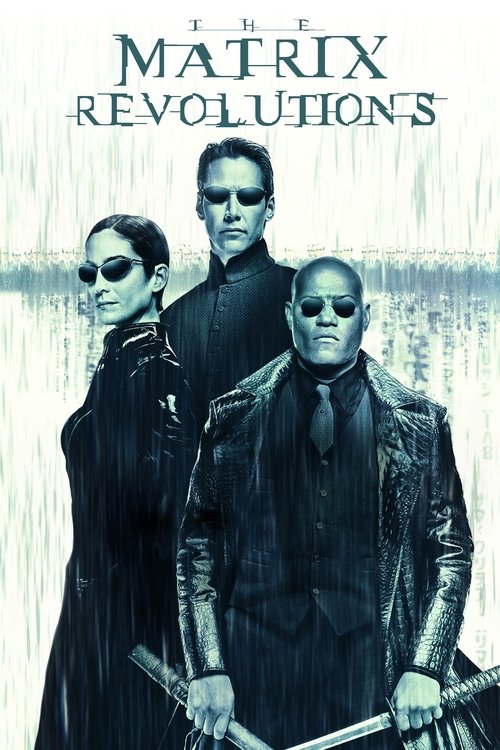
The Matrix Revolutions
The trilogy finale turns cyberpunk rebellion into siege movie, sacrifice myth, and uneasy truce with the machine world.
Latest video signal
Trailer slot ready
A widescreen slot for the newest official trailer, interview, or scene signal when the page has a playable source.
Why it matters
The Matrix Revolutions matters because it completes the Wachowskis’ pivot from individual awakening to collective survival. It is less interested in topping the first film’s cool than in asking what peace costs when both humans and machines are trapped inside cycles of war.
Craft read
Zion siege spectacle paired with Neo’s sacrificial movement toward negotiation and transcendence
More operatic, mournful, and spiritual than the sleek paranoia of the original
Completes Matrix trilogy programming for cyberpunk, machine-war, and messianic-sci-fi lanes
Themes
Cast and context
matrix • machine war • zion • sacrifice • finale
Lana Wachowski & Lilly Wachowski currently has 5 live movie pages in Cinema One.
View director pageCoverage status
A strong case file with real editorial shape: enough craft, context, and connection to guide a serious watch.
Production notes
- • The Zion battle emphasizes bodies, machines, ammunition, exhaustion, and community rather than the weightless cool of the simulation.
- • Neo and Smith’s final confrontation works as a philosophical stalemate as much as a physical fight: opposition has become dependency.
- • A necessary finale page because it frames the trilogy as a movement from escape to coexistence, however fragile.
Watch-next pathway
What should you do after The Matrix Revolutions?
Three intentional continuations: stay with the filmmaker, chase the dominant pressure signal, or jump into the shelf or argument that best explains why this movie belongs here.
The Matrix
The cleanest next move if Lana Wachowski & Lilly Wachowski's control, obsessions, or rhythm are what hooked you here.
More sacrifice
Use the taste map to find movies, arguments, and shelves that share this page's strongest signal.
Machine Nightmares
Cold systems, synthetic threats, and movies where technology stops feeling like a tool and starts feeling like an adversary.
Movie-page argument
Defend The Matrix Revolutions.
If this movie has a scene, performance, ending, or idea people underrate, make the case. The best defenses can become future Cinema One argument material.
Scene challenge
Pick the scene that proves it.
Cinema One is built around scenes that unlock the movie. Tell us which moment carries the pressure, style, argument, or rewatch charge.
Signature scene: Neo chooses the machine city instead of another victory pose
The final movement matters because Neo does not win by simply defeating the system from outside it. He enters the source of machine power and bargains through vulnerability, turning the climax into sacrifice rather than conquest.
Line worth carrying forward
“Everything that has a beginning has an end.” The phrase gives the finale its ritual shape, promising closure while admitting that endings arrive through cost, repetition, and surrender.
Why the ending is deliberately uneasy
The peace at the end is not triumphalist, which is why it remains interesting. The machines stop, the sky opens, and the Oracle speaks in hope rather than certainty. The movie gives the war an ending without pretending history has become simple.
Steelman the debate
A fair critique is that Revolutions sidelines some of the original’s most exciting conceptual pleasures in favor of siege spectacle and solemn myth. The best defense is that the trilogy has changed scale: the question is no longer how one person wakes up, but how worlds stop destroying each other.
More from this director
Related picks
Read next
Cameron’s sequel works because it does not simply supersize Ridley Scott’s terror. It rebuilds the xenomorph threat around group collapse, siege pressure, and Ripley’s protective ferocity.
James Cameron’s sequel gets larger, louder, and more advanced, but it stays alive because every escalation feeds the movie’s protector-child-parent triangle.
Kill Bill: Vol. 1 still rips because Tarantino treats genre citation as movement, not trivia, building a revenge movie that keeps changing shape without losing its line of attack.