
The Wild Robot
Find the movies with rewatch gravity, live dossiers, and unfinished cases worth deepening.
Movie dossier
The Wild Robot
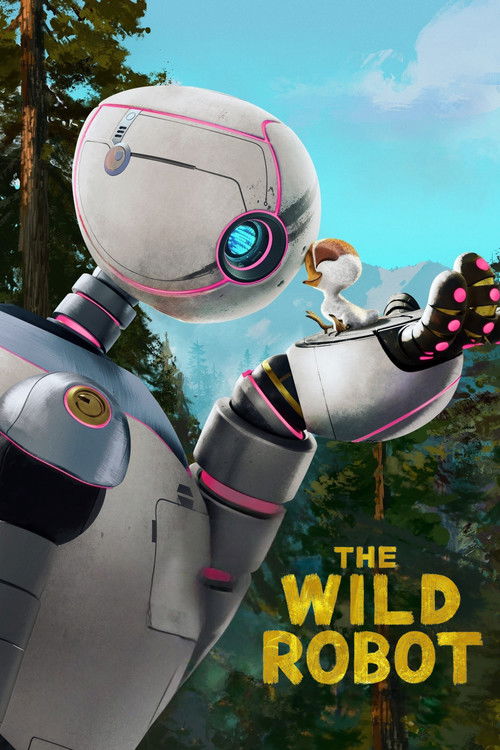
DreamWorks turns a stranded helper machine into a painterly survival movie about adaptation, parenthood, and earned belonging.
Latest video signal
Trailer slot ready
A widescreen slot for the newest official trailer, interview, or scene signal when the page has a playable source.
Why it matters
The Wild Robot matters here because it adds a modern Thomas Library Spine title that broadens the site without softening it into family-film wallpaper. Roz is built to complete assigned tasks, but the island keeps giving her conditions instead of instructions: weather, predators, hunger, migration, a gosling who needs more than efficiency, and a body that slowly stops looking factory-clean. Chris Sanders makes the movie work by treating animation as behavior. The brush-stroke surfaces, silent-film movement, Lupita Nyong’o’s calibrated voice, and Brightbill’s flight arc all push the same argument — love is not what Roz was programmed to do, but responsibility teaches her a new operating system.
Craft read
A survival-and-parenthood story where every task becomes a test of whether Roz can adapt beyond utility
The island runs on instinct, seasons, death, migration, and earned trust; Roz has to learn those rules without becoming only another machine solving inputs
Roz’s surface, movement, and voice keep changing in small increments, so the second watch is about seeing belonging arrive before the character can name it
Themes
Cast and context
wild robot • chris sanders • lupita nyongo • dreamworks animation • painterly animation • found family • migration • adaptation
Coverage status
A strong case file with real editorial shape: enough craft, context, and connection to guide a serious watch.
Production notes
- • Animation Magazine records Sanders pushing DreamWorks toward a radically painterly final image after falling for the looseness of early development art, including a color-dailies moment where a shot looked like a painting until it started to move.
- • Sanders told Letterboxd that Roz begins as the only fully CG-looking surface in the film, then gradually picks up damage, patina, and painted texture until she visually belongs to the island by the third act.
- • Letterboxd’s Sanders interview also notes the animation team looking to silent-film performers such as Buster Keaton for Roz’s pantomime, an important craft key because the character has no mouth and cannot rely on ordinary facial acting.
Watch-next pathway
What should you do after The Wild Robot?
Three intentional continuations: stay with the filmmaker, chase the dominant pressure signal, or jump into the shelf or argument that best explains why this movie belongs here.
More animation craft
Use the taste map to find movies, arguments, and shelves that share this page's strongest signal.
Survival Systems
Movies where staying alive means reading rules, terrain, logistics, and bodies faster than the danger can adapt.
Movie-page argument
Defend The Wild Robot.
If this movie has a scene, performance, ending, or idea people underrate, make the case. The best defenses can become future Cinema One argument material.
Scene challenge
Pick the scene that proves it.
Cinema One is built around scenes that unlock the movie. Tell us which moment carries the pressure, style, argument, or rewatch charge.
Signature scene: the migration lesson turns parenting into engineering with a heart rate
Brightbill learning to fly is the unlock because the movie refuses to separate feeling from craft. Roz can calculate, observe, build, and encourage, but none of that matters unless the gosling can trust his own body in the air. The scene works as family drama and action diagram at once: parenthood becomes preparation for a moment the parent cannot control.
Line worth carrying forward
“Sometimes, to survive, we must become more than we were programmed to be.” That line could have been bumper-sticker philosophy. In The Wild Robot, it lands because the movie has already made the body prove it: scratches, moss, new movement, new speech rhythm, and one machine choosing care when care is no longer just a task.
Why the ending keeps the ache
The ending works because it understands that belonging does not erase origin. Roz can love the island and still be pulled back toward the system that made her; Brightbill can survive because she lets him go. The movie earns its tears by making separation part of the operating system, not an emotional cheat code.
Steelman the debate
The fair critique is that The Wild Robot can tilt broad and sentimental, especially once the island community starts organizing around Roz. The defense is that Sanders earns the sentiment through visible craft pressure. The movie does not just announce that a robot became a mother; it changes her texture, movement, voice, priorities, and relationship to death until the feeling has physical evidence.
More from this director
Related picks
Read next
Interstellar keeps surviving backlash cycles because Nolan ties its cosmic spectacle to separation, time loss, and family grief.
The real reason to track Dune: Messiah early is that it could force blockbuster franchise culture to sit inside consequence instead of momentum.
Fincher’s Dragon Tattoo remake endures because research, pattern recognition, and bruised trust become as gripping as any chase scene.