
The Creator
Find the movies with rewatch gravity, live dossiers, and unfinished cases worth deepening.
Movie dossier
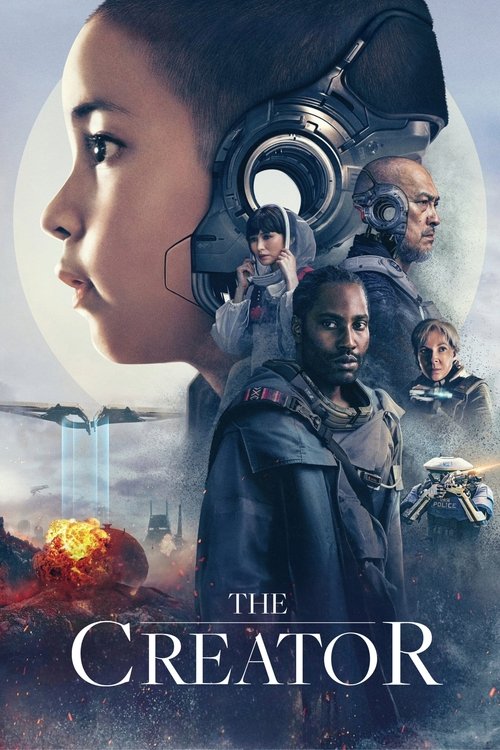
The Creator
Gareth Edwards makes original sci-fi feel like a war-zone travelogue: tactile, dusty, retro-futurist, and built around one child-shaped moral problem.
Latest video signal
Trailer slot ready
A widescreen slot for the newest official trailer, interview, or scene signal when the page has a playable source.
Why it matters
The Creator matters here because it is the rare modern studio sci-fi object that does not feel assembled on a showroom floor. The script is blunt, but the images have appetite: robots standing in rice fields, monks beside machines, tanks moving through villages, and a child AI turning the war plot into a question of custody. Edwards keeps the spectacle close to ground level, so the movie’s best argument is formal: future shock hits harder when it looks like someone found it with a camera instead of rendering it behind glass.
Craft read
A soldier-and-child pursuit story wrapped around an AI war and a grief-driven rescue mission
Every tactical order is also a moral test of whether Joshua can see past the briefing language
Location-first photography, retro tech design, and ILM paint-over worldbuilding make the future feel found, not manufactured
Themes
Cast and context
artificial intelligence • original sci-fi • gareth edwards • industrial light and magic • southeast asia • robots • field-footage spectacle
Coverage status
A strong case file with real editorial shape: enough craft, context, and connection to guide a serious watch.
Production notes
- • Lucasfilm reported that Edwards operated camera alongside Greig Fraser and Oren Soffer and shot largely on location across Southeast Asia, including Thailand, Vietnam, and Japan, while avoiding green screen whenever possible.
- • ILM described the production as an unusual collaboration: Edwards and producer Jim Spencer first gathered documentary-style footage in Asia, then ILM used rapid paint-over and projection work to prove the world could be built into real locations.
- • IndieWire framed the process as a reversal of normal blockbuster VFX: Edwards shot across 80 Southeast Asian locations with a small crew, natural light, no mo-cap suits, no tracking markers, and no green or blue screen, then designed much of the sci-fi layer after the edit took shape.
Watch-next pathway
What should you do after The Creator?
Three intentional continuations: stay with the filmmaker, chase the dominant pressure signal, or jump into the shelf or argument that best explains why this movie belongs here.
More artificial intelligence
Use the taste map to find movies, arguments, and shelves that share this page's strongest signal.
Survival Systems
Movies where staying alive means reading rules, terrain, logistics, and bodies faster than the danger can adapt.
Movie-page argument
Defend The Creator.
If this movie has a scene, performance, ending, or idea people underrate, make the case. The best defenses can become future Cinema One argument material.
Scene challenge
Pick the scene that proves it.
Cinema One is built around scenes that unlock the movie. Tell us which moment carries the pressure, style, argument, or rewatch charge.
Signature scene: the village raid turns scale into moral geography
The village combat works because the machines do not float above the world. They push through houses, fields, smoke, bodies, and scared faces, so the spectacle keeps brushing against civilians instead of becoming clean hardware porn. That is the movie’s strongest move: the future arrives as occupation texture, and Joshua’s mission starts to look less like extraction than complicity.
Line worth carrying forward
“They’re not people.” The line is ugly because the movie uses it like a permission slip. The Creator is at its sharpest when it shows how quickly language turns a living face into a targetable object.
Why the ending goes for myth instead of argument
The finale chooses emotional release over rigorous politics, but that choice also reveals what Edwards wants from the movie: not a policy paper about AI, but a big, wounded image of a child breaking the war machine’s logic. Whether that fully lands is debatable; the visual conviction is the reason the movie stays in rotation.
Steelman the debate
The critique is fair: The Creator can flatten its politics and character turns into broad sci-fi fable. The defense is that original sci-fi rarely gets this much tactile worldbuilding at studio scale anymore, and Edwards gives the film enough handmade visual pressure that even the obvious beats feel housed in a real cinematic world.
Shows up in
Movies where staying alive means reading rules, terrain, logistics, and bodies faster than the danger can adapt.
Cold systems, synthetic threats, and movies where technology stops feeling like a tool and starts feeling like an adversary.
More from this director
Related picks
Read next
Tarantino’s war fantasia works because the suspense is not built on firefights first. It is built on who can control the room, the accent, the cover story, and the next sentence.
Paul Verhoeven’s classic is not just a cyborg action movie, it is a brutal joke about what happens when corporate logic gets hold of the human body.
The Matrix changed action cinema because the Wachowskis made philosophy, rebellion, and image-system cool feel like the same piece of entertainment.