
American History X
Find the movies with rewatch gravity, live dossiers, and unfinished cases worth deepening.

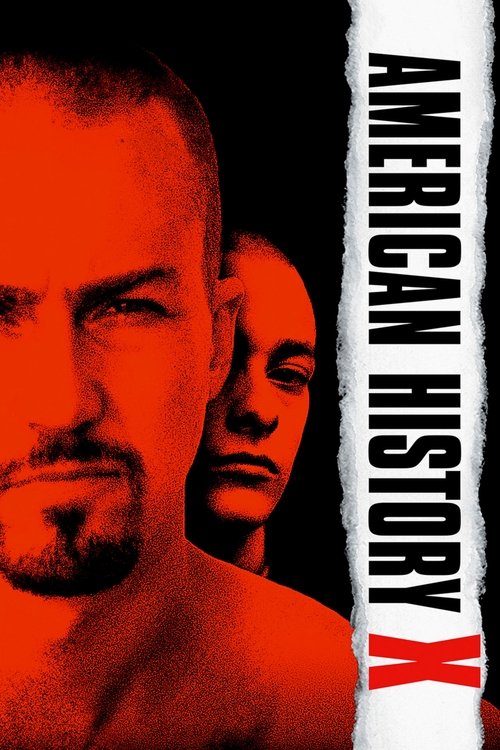
Movie dossier
American History X
A furious anti-hate drama where ideology spreads through performance, family inheritance, and the terrible efficiency of a younger brother watching.
Latest video signal
Trailer slot ready
A widescreen slot for the newest official trailer, interview, or scene signal when the page has a playable source.
Why it matters
American History X matters because it refuses to keep extremism at the safe distance of issue-film abstraction. Tony Kaye and David McKenna build the movie around charisma, humiliation, memory, and consequence, then keep dragging the cost back into the home: dinner-table permission, schoolyard imitation, bedroom mythology, and the awful fact that Derek becomes most dangerous when Danny sees him as proof of manhood.
Craft read
A 24-hour present-tense rescue mission crosscut with the black-and-white myth of how Derek became an image Danny could inherit
Edward Norton makes Derek frightening because the intelligence, charm, posture, and fury all understand audience control
The movie keeps its force because its own iconography is unstable: it condemns hate while showing how easily hate borrows cinematic glamour
Themes
Cast and context
racism • redemption • brotherhood • prison • hate crime • transformation
Coverage status
A fully shaped Cinema One case: the movie has enough authored context, pathway links, and argument to feel like more than a catalog entry.
Production notes
- • AFI records Kaye as both director and cinematographer, with Jerry Greenberg and Alan Heim credited as editors; that authorship split matters because the movie’s visible style and disputed final shape are both part of its afterlife.
- • Roger Ebert noted the film’s black-and-white past and color present, and argued that its most convincing material is the skinhead bonding: speechmaking, tattoos, music, beer, drugs, and the need to belong to something larger than yourself.
- • The Guardian’s final-cut reporting makes the post-production fight part of the film’s texture: Kaye disowned the released version after New Line allowed Norton to help oversee a second edit, and Kaye later filed a lawsuit against New Line and the DGA that was dismissed in 2000.
Watch-next pathway
What should you do after American History X?
Three intentional continuations: stay with the filmmaker, chase the dominant pressure signal, or jump into the shelf or argument that best explains why this movie belongs here.
More radicalization
Use the taste map to find movies, arguments, and shelves that share this page's strongest signal.
Status Traps
Ambition, reputation management, and movies where climbing the ladder quietly poisons the people doing it.

Movie-page argument
Defend American History X.
If this movie has a scene, performance, ending, or idea people underrate, make the case. The best defenses can become future Cinema One argument material.

Scene challenge
Pick the scene that proves it.
Cinema One is built around scenes that unlock the movie. Tell us which moment carries the pressure, style, argument, or rewatch charge.
Production file
How the movie became this object
Fractured authorship is part of the case file
American History X should not be flattened into either a clean anti-hate lesson or a behind-the-scenes scandal. The useful Cinema One read is that both pressures belong on the page. Kaye’s high-contrast photography gives Derek’s past the force of terrible myth, while the released cut keeps bending the movie back toward Derek’s conversion and Danny’s imitation. The finished film feels powerful partly because it is fighting itself: image against argument, charisma against warning, redemption shape against damage already passed down.
Signature scene: the curb sequence turns swagger into permanent horror
The curb scene matters because the movie does not stage violence as release, even if Derek wants the room to read it that way. It lets cultivated command curdle into something irreducibly monstrous, then makes the rest of the film live under that image. The scene is the page’s warning label: cinematic power can expose hatred, but it can also become the thing a broken audience remembers too well.
Line worth carrying forward
"Has anything you’ve done made your life better?" The question lands because it punctures ideology without trying to out-shout it. It is the movie’s cleanest expression of moral confrontation as something quieter and harder than rhetoric.
Why the ending still stings
American History X ends by denying the fantasy that recognition automatically breaks the cycle. The final tragedy is brutal because the movie has spent so much time showing how hate reproduces itself through homes, stories, humiliation, and imitation, not just through one man’s beliefs.
Steelman the debate
The serious critique is that the film’s intensity can make Derek too magnetic, giving white-power iconography a charge the movie cannot fully control. The strongest defense is that this discomfort is the actual argument when the page frames it honestly. American History X is most useful where it shows charisma as recruitment technology: posture, certainty, brotherly awe, and false clarity arriving before consequence becomes legible.
More from this director
Related picks
Read next
Tony Kaye’s drama still hits because it understands hatred as something performed, inherited, and normalized at home before it hardens into ideology.
Benjamin Button matters because Fincher treats the reverse-aging premise less like a trick than a way to make timing itself feel tragic.
Tarantino’s debut still crackles because it treats the failed heist as an excuse to trap voice, ego, and suspicion in one room until everyone starts bleeding through their own performance.