
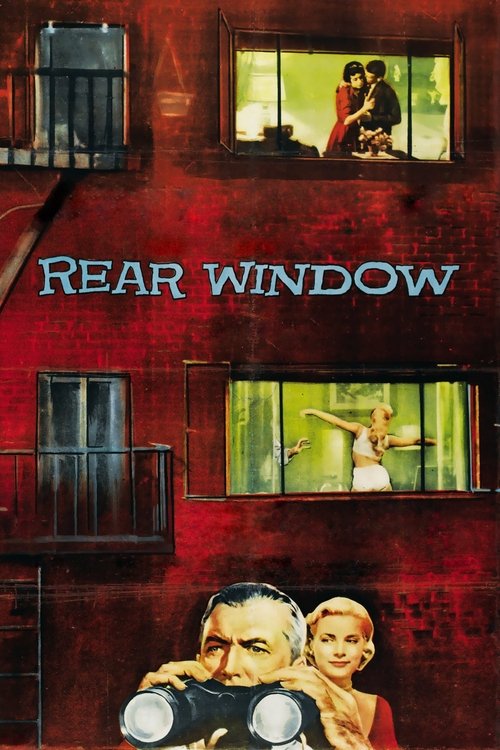
Rear Window
Find the movies with rewatch gravity, live dossiers, and unfinished cases worth deepening.
Movie dossier
Rear Window
A suspense classic that turns looking itself into the source of pleasure, guilt, and danger.
Latest video signal
Trailer slot ready
A widescreen slot for the newest official trailer, interview, or scene signal when the page has a playable source.
Why it matters
Rear Window matters because Hitchcock reduces cinema to its nerve endings: space, attention, suspicion, desire, and the terrible thrill of thinking you have seen too much. It is one of the clearest movies ever made about spectatorship without becoming abstract homework.
Craft read
One courtyard, one immobilized observer, and an entire suspense system built from restricted vision
Playful romance curdling steadily into anxiety and moral unease
A foundational text for suspense, voyeurism, and movies-about-looking
Themes
Cast and context
voyeurism • murder • wheelchair • apartment • photographer • suspense
Coverage status
A fully shaped Cinema One case: the movie has enough authored context, pathway links, and argument to feel like more than a catalog entry.
Production notes
- • Built almost entirely on a massive courtyard set, which gives the movie its theatrical precision.
- • James Stewart and Grace Kelly make the film both flirtatious and nervy, not just schematic.
- • One of Hitchcock's most teachable and endlessly rewatchable masterpieces.
Watch-next pathway
What should you do after Rear Window?
Three intentional continuations: stay with the filmmaker, chase the dominant pressure signal, or jump into the shelf or argument that best explains why this movie belongs here.
Psycho
The cleanest next move if Alfred Hitchcock's control, obsessions, or rhythm are what hooked you here.
More voyeurism
Use the taste map to find movies, arguments, and shelves that share this page's strongest signal.
Master of Suspense
Voyeurism, pursuit, wit, and movies that make point of view feel dangerous.
Movie-page argument
Defend Rear Window.
If this movie has a scene, performance, ending, or idea people underrate, make the case. The best defenses can become future Cinema One argument material.
Scene challenge
Pick the scene that proves it.
Cinema One is built around scenes that unlock the movie. Tell us which moment carries the pressure, style, argument, or rewatch charge.
Signature scene: Lisa crosses the courtyard while Jeff can only watch
Rear Window becomes unbearable in the best way when Lisa enters Thorwald's apartment and Jeff is reduced to pure spectatorship. Hitchcock turns distance into helplessness. The scene proves the film is not just about seeing danger, but about how awful it feels when seeing is all you can do.
Line worth carrying forward
"We've become a race of Peeping Toms" is the movie giving away its own method. Hitchcock is teasing the audience and indicting it at the same time, which is exactly why the film feels so alive instead of merely respectable.
Why the ending satisfies without letting anyone fully off the hook
The ending works because the mystery resolution is only half the pleasure. Hitchcock restores order, but he leaves the movie's more interesting discomfort intact: Jeff was right to look, but the film never lets looking become innocent.
Steelman the debate
A fair critique is that Rear Window can seem too neat, too pleased with its own conceptual elegance compared with Hitchcock's darker or more psychologically torn films. The best defense is that the elegance is the weapon. Hitchcock makes formal cleanliness produce moral mess, which is why the movie keeps deepening instead of flattening with familiarity.
More from this director
Related picks
Read next
Rear Window turns voyeurism into suspense because Hitchcock understands that looking is never passive once desire, guilt, and curiosity start mixing together.
North by Northwest still feels fresh because Hitchcock treats mistaken identity as an excuse to build one of the great motion machines in studio-era cinema.
The Birds remains uncanny because Hitchcock refuses to turn catastrophe into a puzzle with a satisfying answer.