
National Lampoon's Animal House
Find the movies with rewatch gravity, live dossiers, and unfinished cases worth deepening.

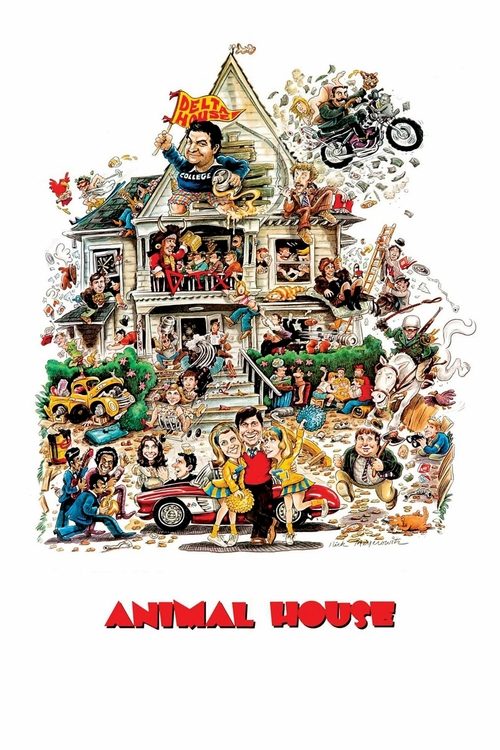
Movie dossier
National Lampoon's Animal House
Anarchy as campus comedy, where bad behavior becomes a whole anti-authoritarian style system.
Latest video signal
Trailer slot ready
A widescreen slot for the newest official trailer, interview, or scene signal when the page has a playable source.
Why it matters
Animal House matters because it helped hardwire the DNA of modern American gross-out and ensemble rebellion comedy. John Landis does not treat college life as coming-of-age refinement; he treats it as an arena for class resentment, prank escalation, and anti-establishment release, all pushed through unforgettable comic caricature.
Craft read
Sketch-like comic set pieces linked by escalating fraternity chaos
Belushi turns pure disruptive energy into the movie’s mascot and myth
A blueprint text for raunchy campus comedy and anti-authority group dynamics
Themes
Cast and context
college • fraternity • 1960s • pranks • toga party • john belushi
Coverage status
A strong case file with real editorial shape: enough craft, context, and connection to guide a serious watch.
Production notes
- • Belushi’s Bluto is central, but the film works because the whole Delta house feels like an ecosystem of different failure styles and survival tactics.
- • Landis directs with enough momentum that the movie keeps feeling like a party always one bad idea away from collapse.
- • A valuable Cinema One page because comedy history matters here, and this film is one of the key bridges between countercultural looseness and mainstream studio comedy.
Watch-next pathway
What should you do after National Lampoon's Animal House?
Three intentional continuations: stay with the filmmaker, chase the dominant pressure signal, or jump into the shelf or argument that best explains why this movie belongs here.
More rebellion
Use the taste map to find movies, arguments, and shelves that share this page's strongest signal.
A foundational argument for chaos-comedy that treats bad behavior as a whole anti-authority performance style.
Use this for comedy-history primers, campus-chaos programming, and arguments about movies that turned rebellion into a repeatable studio format.
Movie-page argument
Defend National Lampoon's Animal House.
If this movie has a scene, performance, ending, or idea people underrate, make the case. The best defenses can become future Cinema One argument material.

Scene challenge
Pick the scene that proves it.
Cinema One is built around scenes that unlock the movie. Tell us which moment carries the pressure, style, argument, or rewatch charge.
Signature scene: the toga party turns excess into communal myth
The toga sequence is Animal House distilled to pure reputation. It is not important because of plot advancement; it matters because the movie understands that communal comic memory often comes from atmosphere, costume, noise, and the feeling that decorum has fully lost control.
Line worth carrying forward
"Was it over when the Germans bombed Pearl Harbor?" is funny because it is aggressively, confidently wrong. The line captures the film’s whole comic posture, ignorance transformed into rallying energy so forceful that accuracy no longer matters.
Why the ending embraces mayhem over maturation
Animal House lands by refusing the tidy lesson structure many campus stories would reach for. The parade climax turns grievance into spectacle and lets sabotage itself function as catharsis, which is exactly right for a movie whose deepest loyalty is to comic rebellion, not self-improvement.
Steelman the debate
A serious critique is that Animal House’s canon status can blur how much of its humor depends on crude gender politics and the permissive ugliness of its era. The strongest defense is historical rather than exculpatory: the movie remains important because it defined a comic mode so influential that later films spent decades either copying it, sanitizing it, or arguing against it.
Shows up in
Collection pathway still being shaped.
More from this director
Related picks
Read next
Cameron’s action-comedy stays watchable because it never treats the marriage plot as filler. Embarrassment, deception, and spectacle are all part of the same propulsion system.
The real reason to track Dune: Messiah early is that it could force blockbuster franchise culture to sit inside consequence instead of momentum.
Fincher’s Dragon Tattoo remake endures because research, pattern recognition, and bruised trust become as gripping as any chase scene.